The Science of Bravery: Brain Rewiring for Courage (Neuroscience of Bravery + Mental Strength Training)
![[HERO] The Science of Bravery: How to Rewire Your Brain for More Courage](https://images.squarespace-cdn.com/content/v1/68a273b291136113e94bb305/f12f4eeb-12aa-48a3-a057-3db22cd43c92/4.jpg)
Here's something that might surprise you: courage isn't a personality trait you're born with. It's not some magical quality that brave people have and you don't. It's actually a neurological process, a specific set of brain circuits that you can strengthen, train, and build over time.
Yeah, your brain literally has a "courage circuit." And just like you can train your muscles at the gym, you can train your brain to handle fear better.
If you've ever felt frozen in a moment when you wanted to speak up, take a risk, or make a big life change, you're not weak. You're just human. Your brain is doing exactly what it's designed to do: protect you from perceived threats. The good news? You can rewire it.
Your Brain on Fear: What's Actually Happening
Let's start with the villain of our story: the amygdala. This almond-shaped region of your brain is your personal security guard. It's constantly scanning for danger, and when it spots something threatening (or even thinks it spots something threatening), it hits the panic button.
That panic button releases stress hormones like cortisol and adrenaline. Your heart races. Your palms sweat. Your thoughts get scattered. You know the feeling.
But here's where it gets interesting. You also have a part of your brain called the prefrontal cortex: specifically, the orbitofrontal cortex (OFC): that acts like a wise, logical advisor. This is the part of your brain that can look at the fear signal from your amygdala and say, "Hold on. Is this actually dangerous, or just uncomfortable?"
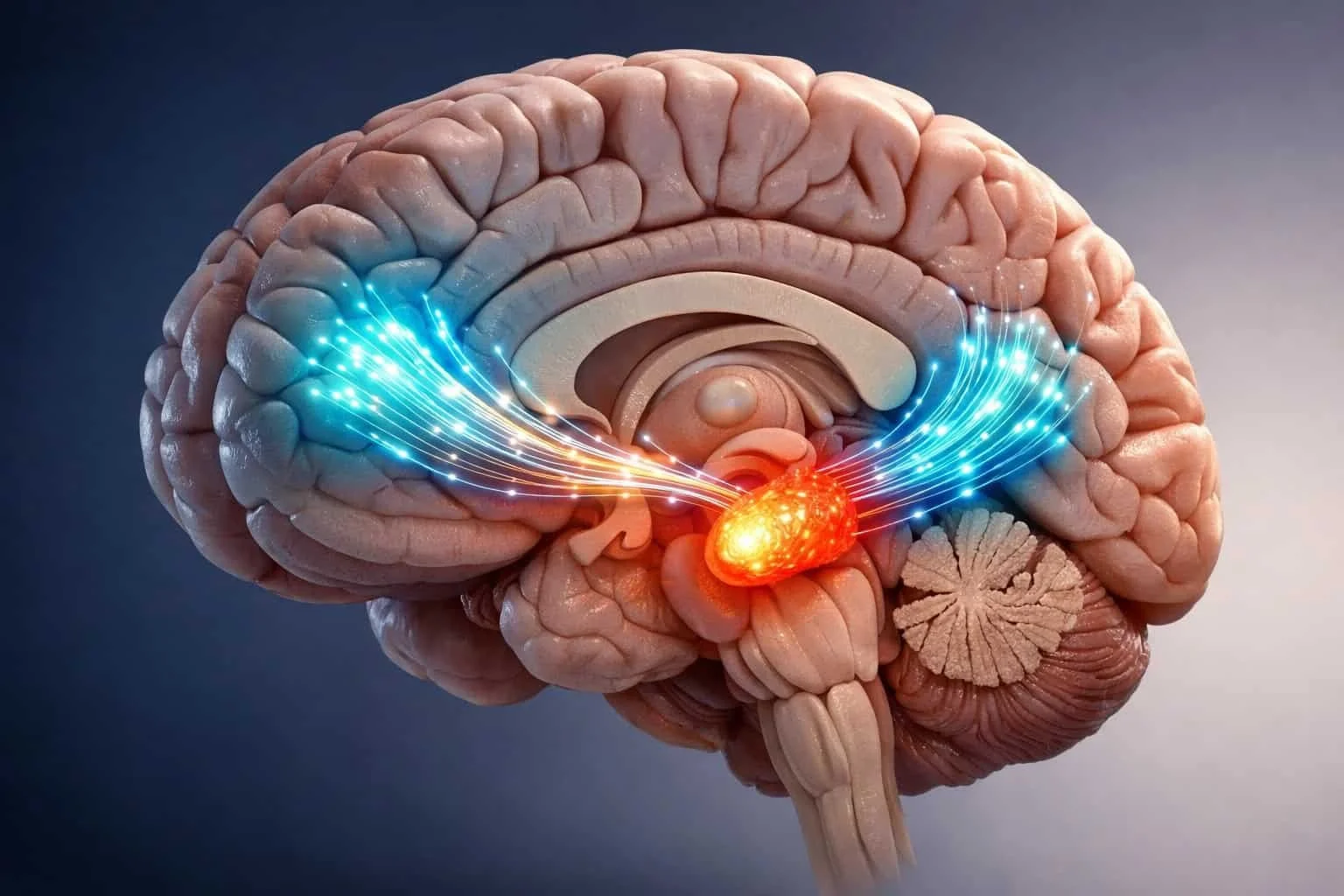
When your prefrontal cortex is strong and well-trained, it can override that initial fear response. It can make a deliberate choice aligned with your values, even when your amygdala is screaming at you to run away. That choice: that override: is what courage actually is.
Courage isn't the absence of fear. It's your brain making a conscious decision to act despite the fear.
The Courage Circuit: Your Brain's Hidden Superpower
Recent neuroscience research has identified what scientists are literally calling a "courage circuit" in your brain. This is a neural pathway that connects an area called the nucleus reuniens to your medial prefrontal cortex.
When this circuit is activated, something fascinating happens: instead of freezing or running away, your brain produces a fight response. Not in an aggressive, lose-control kind of way: but in a "I'm choosing to face this" kind of way.
Think of it like this: your amygdala is the smoke detector. Your courage circuit is the person who investigates whether it's an actual fire or just burnt toast. The more you activate this circuit, the stronger it gets. And the stronger it gets, the more naturally courageous you become.
This isn't motivational fluff. This is neuroplasticity in action: your brain's ability to physically rewire itself based on what you do repeatedly.
Brain Rewiring for Courage: 3 Science-Backed Ways to Train Bravery
So how do you train this courage circuit—this real-world brain rewiring for courage? How do you make your prefrontal cortex strong enough to stand up to your amygdala's fear signals, and learn how to overcome fear naturally?
Science gives us three proven approaches.
1. Repeated Exposure to Fear (The Smart Way)
This one sounds intense, but stick with me. The idea is simple: regularly face situations that trigger fear in a rational, controlled way. Not recklessly. Not dangerously. But consistently.
Every time you step into a fear-inducing situation: whether that's having a difficult conversation, trying something new, or making yourself vulnerable: you're doing two things:
First, you're gradually desensitizing your amygdala. Over time, it learns that this thing isn't actually a life-threatening emergency. The anxiety response gets quieter.
Second, you're activating your brain's dopamine reward system. Neuroscientist Dr. Andrew Huberman explains it like this: "stepping into threats in a rational way...over and over starts to create more activation in the so-called courage circuit." Each courageous action literally becomes more rewarding and pleasurable to your brain.

Start small. If public speaking terrifies you, start by speaking up once in a small meeting. If asking for what you want feels impossible, practice with low-stakes situations first. The key is consistency: you're building new neural pathways, and that takes repetition.
2. Mental Rehearsal and Visualization
Here's the cool part: your brain doesn't fully distinguish between vividly imagined experiences and real ones. When you visualize yourself acting courageously, you're actually activating your prefrontal cortex and strengthening the neural pathways involved in brave action.
This is why elite athletes spend hours visualizing their performance. They're literally training their brains without moving their bodies.
Try this: before a situation that scares you, spend a few minutes visualizing yourself handling it with courage. See yourself speaking clearly, standing tall, making the choice you want to make. Feel what it feels like to be that version of you. You're priming your courage circuit for the real thing.
3. Calm Your Limbic System Through Contemplative Practice
Your limbic system: which includes that overactive amygdala: can be regulated through practices like meditation and mindfulness. This isn't about becoming a zen monk. It's about teaching your brain to not immediately hit the panic button every time something feels uncomfortable.
Research shows that regular meditation can actually change the structure of your amygdala, making it less reactive to perceived threats. Even just 10 minutes a day can make a measurable difference over time.
Some studies are even exploring whether transcranial magnetic stimulation: a technique that uses magnetic fields to stimulate specific brain areas: can strengthen courage networks directly. We're living in the future, folks.

The Neuroplasticity Factor: Why This Actually Works
All three of these methods work because of one fundamental principle: neuroplasticity. Your brain is not fixed. It's constantly rewiring itself based on what you do, think, and practice.
What you do repeatedly strengthens the neural pathways involved in that behavior. Do something courageous once? You've activated the circuit. Do it ten times? You're building the pathway. Do it a hundred times? It starts to become automatic: part of who you are.
This is how courage transforms from a conscious, effortful choice into a natural character trait. You're not becoming a different person. You're training your existing brain to respond differently.
Mental Fortitude Coaching: Turn the Neuroscience of Bravery Into Real-Life Courage
Understanding the science of courage isn't just interesting—it's empowering. When you realize that bravery is a skill you can develop (not a fixed trait you either have or don't have), everything changes.
This is exactly what we work on in mental fortitude coaching. We're not just talking about "being brave" in abstract terms. We're using practical mental strength training—grounded in the neuroscience of bravery—to help you build steady, repeatable brain rewiring for courage.
That means structured, science-backed practices that strengthen your courage circuit, train your prefrontal cortex, and help you make choices aligned with your values even when fear shows up.
Because fear will always show up. That's not the problem. The problem is when fear makes all your decisions for you.

When you understand how your brain works: when you know that your amygdala is just doing its job and your courage circuit can be trained: you stop judging yourself for feeling afraid. You stop seeing fear as evidence that you're not ready or not capable.
Instead, you see fear as information. As a signal that something matters to you. And as an opportunity to activate and strengthen your courage circuit one more time.
Your Brain Is Already Capable
Look, you don't need to be fearless to be courageous. You just need to understand that your brain is designed to learn, adapt, and grow stronger through experience.
Every time you choose courage: even in small, seemingly insignificant ways: you're physically changing your brain. You're building neural pathways. You're training your prefrontal cortex to stand up to your amygdala. You're becoming the kind of person who acts on their values instead of their fears.
The science is clear: courage can be trained. Your brain is already capable of rewiring itself. The question isn't whether you can become braver: it's whether you're willing to practice.
Start small. Be consistent. Trust the process. Your courage circuit is waiting to be activated.
And if you want support building that mental fortitude in a structured, science-informed way? That's exactly what we're here for. Check out our coaching services or explore more about building the willpower to achieve your goals.
Your brain is more powerful than you think. Time to put it to work.

Internal ad